
The global B2B market is vast and constantly growing. It is currently valued at $6.64 trillion, and experts predict the B2B industry will grow by over $18 trillion by 2027. In the United States, the overall value of the B2B sector will be $1.8 trillion by the end of 2023.
The rapid pace of technological evolution, ongoing economic disruption, and shifting consumer expectations have all contributed to the B2B boom. For many successful B2B enterprises, referrals have been and will remain a crucial component of growth.
Referral marketing: a tried-and-tested growth driver for B2Bs
From a business perspective, the large majority (84%) of B2B decision-makers say that all their business-related purchases begin with a referral. That can mean a traditional word-of-mouth referral, but it still shows the power of a recommendation from a friend or colleague. Most of the time, B2B companies reach out to certain vendors or suppliers because they were recommended, not because they found them through an extensive product search.
As a result, referral marketing is highly effective:
- An estimated 82% of B2B sales leaders agree that referrals provide them with high-quality leads.
- Almost half (49%) of B2B tech vendors say that using referrals is their most effective marketing strategy.
- The traditional cold call approach is effective in only 1 out of 50 attempts, a 2% success rate.
There is no doubt that B2B enterprises will use referral marketing to grow their customer base and drive more revenue. But in the evolving business landscape, B2B firms need to remodel their referral strategies. The expectations of their target customers have changed, and new technologies have modified, and even introduced, purchasing behaviors.
B2B referral marketing: a different journey
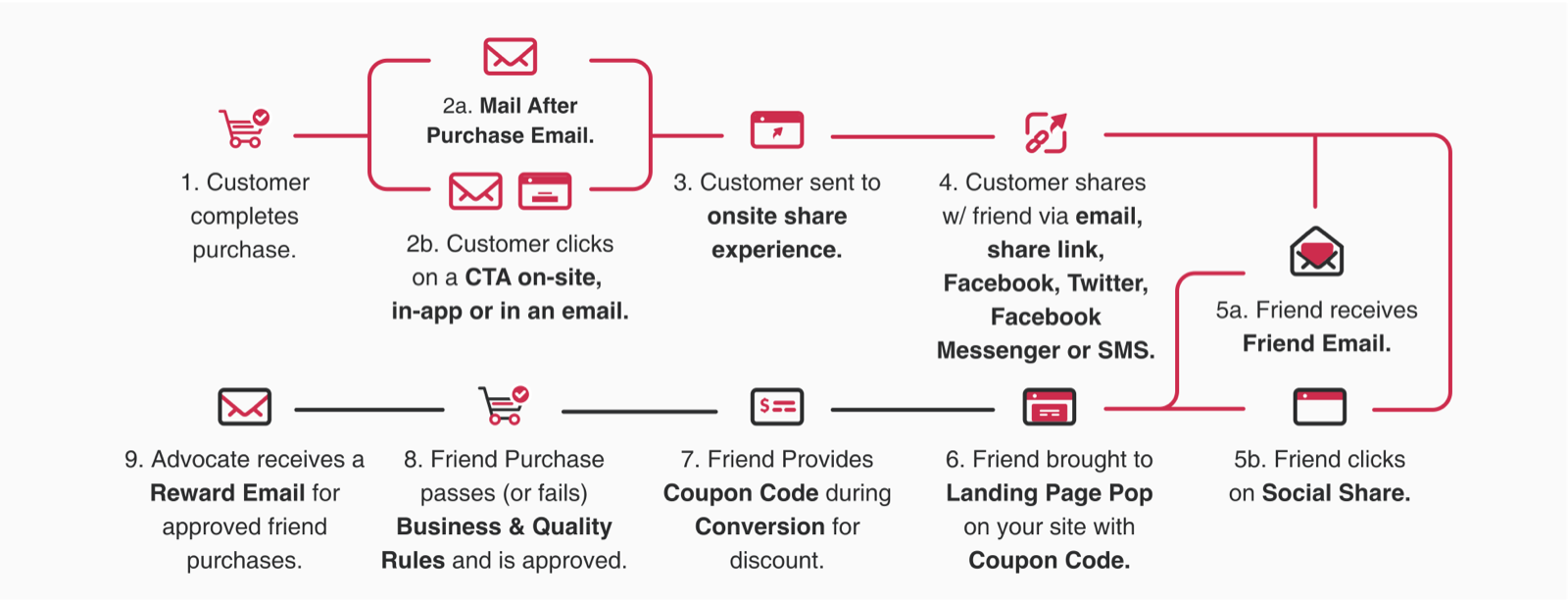
Every good referral program uses rewards. An advocate typically gets a reward when a customer they referred makes a purchase, and the referred customer gets a reward during their first shopping experience to encourage that first transaction. This two-sided reward works best when the value of the advocate's reward closely matches the value of the friend's reward. The typical flow looks like this:
B2B referral marketing is much different from referral strategies designed for B2C retail brands. The most notable difference is the audience. B2B customers are more specific, and usually a smaller and more pointed audience than B2C consumers. Other essential contrasts set B2B referral marketing apart:
- Longer, more extensive decision-making. There are multiple consultations with different people from different departments, extensive research, and several ways of reaching a purchasing decision. Convincing one person is not enough. B2B vendors need the approval of various individuals to even be considered. The final decision rests with the executive team, but other players have to sign off before a purchase can progress.
- Bigger, long-term deals. B2B organizations want purchases that impact the bottom line by solving both immediate and anticipated needs and by enhancing their resiliency in the future. That is the biggest reason decisions take longer.

Best practices around rewards are constantly evolving. Extole recognizes the uniqueness of B2B referrals and follows a different baseline flow for B2B companies. Your reward choice and reward trigger will depend on your flow. Extole looks at your target customers and provides referral programs distinctly focused on the B2B customer profile, while still covering a lot of marketing bases: retention, conversion, and loyalty. More importantly, Extole builds and runs referral programs that deliver the substantial value B2B clients expect and that achieve your brand's acquisition and growth goals.
Below are 30 best practices for optimizing your B2B referral program so it performs its best. If you also sell to consumers, see our companion guide, 32 referral marketing best practices for retailers.
Key takeaways
- Referrals start most B2B purchases, and they produce higher-quality leads than cold outreach.
- B2B buying involves many people and longer decisions, so a referral journey has to work for more than one person.
- Keep sharing simple, make the offer and the reward clear, and reward advocates quickly.
- Qualify and categorize referrals, then use your own data to personalize and to find new segments.
- Be transparent about data use, and set security standards to prevent fraud.
Be straightforward and simple
1. Get the message straight across
B2B buyers are busy and have little time for branded messages. Your call to action and copy need to be direct and blunt right off the bat. They should be specific to the industry and the problem, so they capture attention, are easy to understand, and tell people what to do and what to expect.
2. Promote your programs where advocates and referrals can easily see them
Make sure all users of the product can easily find the program and refer. That might be on their dashboards in the product, in the app, in direct mail, and more. Promote the program where people can easily find it.
3. Make referral programs easy to share
Don't make sharing complicated for advocates or recipients. Make it quick and easy for your B2B referral program by using codes and links, and don't involve too many steps. Otherwise you lose valuable customer acquisition opportunities.
4. Avoid lengthy lead forms
Never be tempted to ask for all of a person's information at the beginning. Require only what you need to accomplish your goal. You can always ask for more later.
5. Enable one-click connections between advocates and the referred
68% of Americans say the identity of the sender influences their decision on whether to open an email, and they are more likely to open one from someone they recognize. Give advocates native sharing tools that let them connect with referral candidates rapidly.
6. Make it easy for recipients to share branded messages and promos
Even if referrals don't convert, they can still pass your promos on to people who are likely to. This matters, as 92% of consumers say they trust referrals from people they know, and they are 4x more likely to purchase when referred by family or a friend.
7. Offer a consistent experience across platforms
The majority of today's customers expect every marketing initiative from brands to be digitally accessible, seamless, and consistent. 76% demand connected journeys. Your referral program has to be accessible and consistent across all digital channels and devices.
Leverage personalized and engaging elements
8. Leverage personalization
B2B businesses are constantly searching for customized experiences. When you ask advocates and referrals to participate, all your interactions and messages should have a personal touch. Referrals are usually the first point of contact between a B2B business and a potential customer.
9. Enable your advocates to personalize their referral messages
Referrals tend to respond positively to branded messages delivered in a familiar voice or tone, and the more personalization, the more impact. The data shows that personalized promotional emails improve unique open rates by 29% and have 41% more unique click-through rates.
10. Make your CTAs large and engaging
Your call to action should be large and prominent on the page. Whether it is a headline or a button, it should catch the customer's eye and invite them to take the next step in your referral program.
11. Include the offer in your CTAs
In one test, a marketer put a descriptive copy of the promo first and the CTA button at the bottom, and that placement produced a 304% conversion lift. Give users a glimpse of your program to make your CTAs more encouraging. Receivers prefer to know more about the offer before they click the CTA button.
12. Use FAQs with all essential information
The quick, easy-to-read format explains your program, and its terms and conditions, to both advocates and referrals. FAQs let you inform readers without making a mess of your main referral page.
Target high-quality referrals with rich rewards
13. Know your current customer satisfaction
Before you start a referral program, develop a deep understanding of your customers' satisfaction. Send out questionnaires to see whether they are happy with your product, and search for reviews and feedback online. Solve your product's issues first, before jump-starting a referral program.
14. Have standard criteria for qualifying referrals
Implement strict criteria and objectives, such as active status for at least two years or membership of the C-suite, to make sure your referrals have high-value potential.
15. Categorize your B2B referrals
You need to know whether your referrals are decision-makers, influencers, or reviewers. Categorize them by their role in their company's purchasing process. Each individual may need a different approach, and so a different journey.
16. Pick B2B incentives that motivate both advocates and referrals
B2B incentives are different from B2B rewards. In the B2B landscape, dollar credit (50%), gift cards (17.6%), and discounts (9.8%) are the most widely used referral reward types.
17. Leverage your existing ambassadors
Do you have businesses and individuals who already refer your organization informally? Are there businesses that would be eager to refer you? Take a pulse of your customers to see how receptive they would be to a referral program.
18. Reward your advocates and referrals fast
The faster people get their rewards, the more engaged they are with your program and your brand.
19. Reward your advocates aggressively
Even if referred users don't perform your desired actions, it is still best to reward your advocates, to encourage them to keep participating and sharing. It also helps avoid WISMR ("where is my reward?") inquiries.
20. Map out the referral journey
Make it easy for your advocates to see what steps they need to take to get their reward. Track and capture all the events in each journey, so you can reward for key events, change the reward triggers easily, and measure customer quality (and drop-off).
21. Monitor your program's effectiveness
Track your participants and see who advocates for your business and takes advantage of your referral program. If referred customers are not capitalizing on the program over time, it might be time to reevaluate.
Get technical
22. Leverage data for powerful customization
Customization is essential to the success of any form of marketing, referral included. Derive insights from customers' data, preferences, and history to supercharge customization and increase the odds of engagement and conversion. Customized copy and CTAs have been found to have 42% higher conversion rates than those with generic messaging.
23. Understand that fonts matter
In marketing, your choice of font, size, and spacing matters as much as the messaging. A psychological study found that people give each font a personality, which affects how they perceive any marketing material. Make sure your font personality matches your brand.
24. Make A/B testing a habit
It is critical to A/B test any or every aspect of your referral program. Testing gives you a clear picture of your campaign and lets you keep optimizing performance to deliver outstanding results.
25. Strategically place QR codes
Make it easy for your users to find and scan your QR codes. Place them where users have direct access: on desktop, so advocates can share from their phones easily; in customer dashboards; and in-store, in-branch, and on printed material. Doing this encourages sharing.
Place a premium on data transparency and security
26. Be transparent about consumer data rights and usage
86% of consumers have grown worried about data privacy. The good news is that 90% of consumers say they are willing to share their data if they have a positive experience with a brand. One sure way for brands to deliver a positive experience is to secure customer information and be transparent about how it is used.
27. Set security standards to prevent fraud
Referral fraud, such as self-referrals, coupon sharing, and return abuse, is a persistent concern for B2B companies that run referral marketing. Brands need to make the configurations and take the measures necessary to identify both high-quality referrals and potentially high-risk ones.
Use data to glean high-value, actionable insights
28. Leverage data for powerful customization
Customization is essential to the success of any form of marketing, referral included. Derive insights from customers' data, preferences, and history to supercharge customization and increase the odds of engagement and conversion. Customized copy and CTAs have been found to have 42% higher conversion rates than those with generic messaging.
29. Capitalize on high-value customer segments revealed by your referral program
Your referral program is brimming with customer information you can use to create exclusive customer segments. Identify your most loyal advocates and most successful referrals, group them together, and create exclusive offers for them.
30. Discover untapped customer segments based on the firm's existing information
B2B organizations have a treasure trove of customer information hidden in their CRMs, ERPs, and other sources. If you are starting a B2B referral program, that is where you should go first.
Experience Extole for yourself
Extole builds and runs referral programs shaped around the B2B customer profile, from the share experience to rewards, fraud controls, and reporting. To learn more about referral programs, request a demo and see how Extole can power customer-led growth for your business.