
For retailers, a refer-a-friend program does something no other form of marketing can. It turns the great experience your existing customers have into a steady stream of new customers. With referral, customer engagement becomes customer acquisition.
The retailers that get the most from referral are the ones that engage customers between and beyond purchases, then make it easy and rewarding to recommend the brand to friends and family. The 32 best practices below, grouped into eight principles of customer-led growth, show how.
How do referral programs work for retailers?
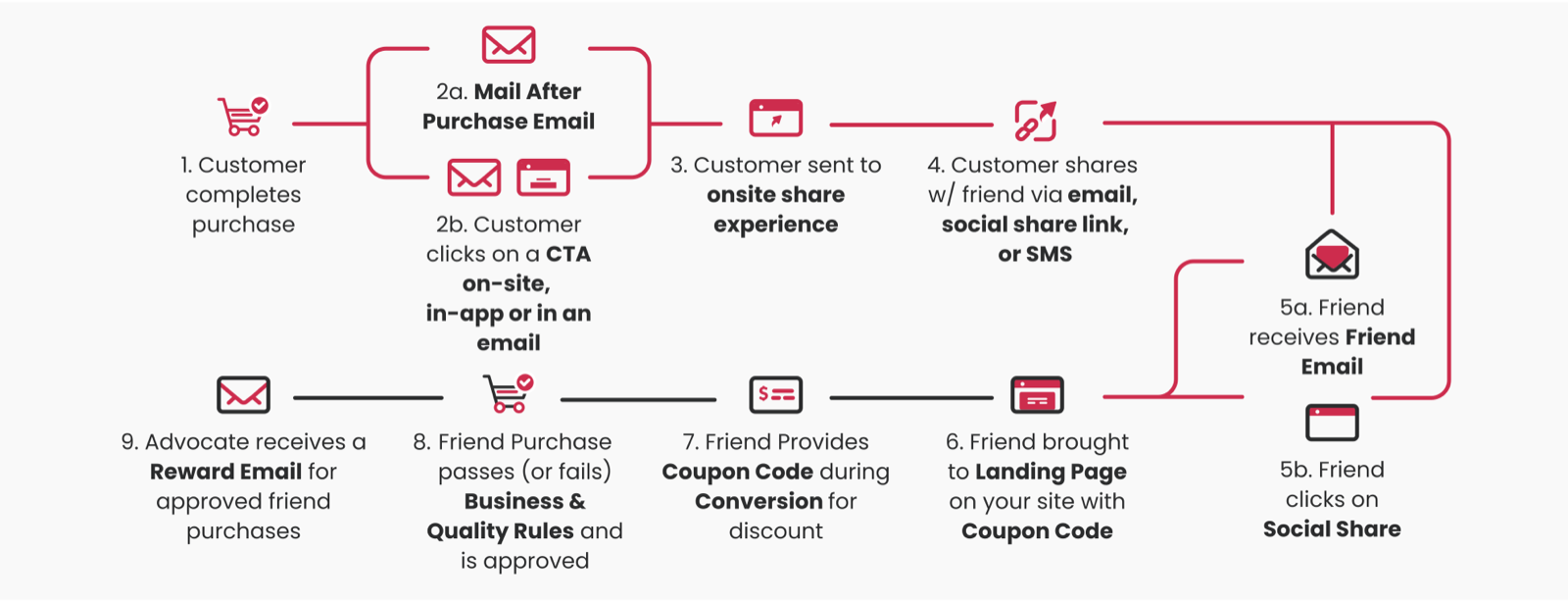
Almost every good referral program runs on rewards. An advocate earns a reward when a friend they referred makes a purchase, and the referred friend gets a reward during their first shopping experience to encourage that first transaction. This two-sided structure works best when the value of the advocate's reward closely matches the value of the friend's reward.
A typical retail referral journey, from the first purchase to the advocate's reward:
Choosing the right rewards
Reward best practices keep evolving. Coupon codes remain the go-to for most retailers, while loyalty points, account credits, and gift cards are appealing alternatives. Account credits help subscription and membership models thrive, and distinctive rewards can enrich the referral experience and deepen the connection with your brand. Whichever you choose, the reward should serve your program goals.

Key takeaways
- Referral turns happy customers into your most efficient source of new customers.
- Two-sided rewards work best when the advocate's and the friend's rewards are closely matched.
- Promote at moments of delight, especially right after purchase.
- Personalize everything: the sharing message, the landing page, and the call to action.
- Protect your program with clear qualification rules, fraud controls, and transparent data practices.
Focus on your advocates
Advocates are the engine of the program, so start with their experience.
1. Enable one-click connections between advocates and their referred friends
68% of Americans say they are more likely to open an email if it's from someone they know. Give advocates native sharing tools that let them connect with referral candidates quickly, and use one-click chat buttons to encourage a real conversation between the person referring and the person referred.
2. Develop a diverse and extensive promotional strategy
The goal is to turn every customer into someone who advocates for your brand. Aim for at least three visible onsite placements where customers can join the program, and make sharing as easy as possible.
3. Make sure the referral offer is competitive
Offer something better than the other offers on your site. If there's no incentive to share your brand, there's little reason for anyone to do it.
4. Offer a consistent experience across platforms, and design with mobile in mind
78% of customers demand connected journeys, so your referral program must be accessible and consistent across every digital channel and device. On mobile, place calls to action above the fold, in mobile menus, and on confirmation overlays.
5. Make sure your advocate has a great experience
Start by asking advocates what makes a great experience, and use data from earlier campaigns to see what works for them and what doesn't. Those insights help you design advocate-centered experiences.
6. Let advocates personalize their referral message
Friends respond well to a message in a familiar voice. The more personalization, the more impact: personalizing promotional emails can improve unique open rates by 29% and unique click-throughs by 41%.
Market after the conversion
The purchase is not the end of the journey. It is often the best moment to ask for a referral.
7. Capitalize on moments of delight
Your highest-performing placements are timed for when a customer is most excited about your brand. In retail, that is usually right after a purchase. Promote post-purchase, with calls to action in triggered emails, thank-you pages, and confirmation page overlays.
8. Thank new advocates after their first share
A thank-you message shows customers how much you value them and strengthens the relationship. 60% of consumers say appreciation should go to both the referrer and the referred, and 44% say thank-you messages should be personalized to feel genuine.
9. Review your strategy if you're not hitting your thresholds
Every referral strategy has its own KPIs. If you're falling short, look closely at where the pain points are and adjust.
Make user journeys delightful

10. Define qualification criteria and communicate them clearly
Be explicit about the eligibility requirements for referrals. Advocates need to know who can send and receive referrals, or they may be deterred from submitting them.
11. Recognize that referred customers are different
A referred customer has a different starting point, different touchpoints, and different motivations and rewards than a standard customer. Tell the friend that someone who loves your brand thinks they will love it too, and that they will get a reward for completing a certain action. Avoid dropping referrals onto a standard landing page, mixing them up with other offers, or ignoring the social proof of the advocate's recommendation.
12. Map out the referral journey
Make it easy for advocates to see the steps they need to take to earn their reward. Capture every event in each journey so you can reward for key events, change reward triggers easily, and measure customer quality and drop-off. Better journeys mean a better customer experience, and an estimated 86% of consumers say they're willing to pay more for better CX.
13. Personalize your landing page
Giving first-time offers to anonymous visitors is great, but referred visitors should land on a page that reinforces their friend's recommendation.
14. Design referral workflows around your business segment
Referral journeys for retail are different from journeys for insurance, so don't shoehorn a retail customer into a journey designed for another industry. A journey built for your segment lets you place touchpoints at the optimal stages and run more efficient, customer-friendly processes.
Get technical
15. Use data for powerful customization
Customized copy and calls to action have been shown to deliver 42% higher conversion rates than generic messaging. Use customers' data, preferences, and history to raise the odds of engagement and conversion.
16. Make A/B testing a habit
Test every aspect of your referral program. Testing gives you a clearer picture of each campaign and lets you keep improving performance.
17. Run reward burst campaigns
Reconfiguring a whole referral campaign takes effort. A faster, less expensive alternative is a time-sensitive offer such as a reward burst, a short-term increase in referral rewards that is proven to attract new customers quickly. For ideas, see our post on running a reward burst.
18. Remember that fonts matter
Font, text size, and spacing matter as much as the message. A psychological study found that people assign personalities to fonts, which affects how they perceive marketing materials, so make sure your font's personality matches your brand.
19. Make sure your buttons match your branding
The color, transparency, and opacity of buttons and calls to action should reflect your brand. Doing so can improve brand recognition by as much as 80% and signals consistency. You can still test colors outside your palette, but sticking with what is familiar rarely goes wrong.
20. Include the offer in your calls to action
In one test, putting descriptive promo copy first and the call to action at the bottom produced a 304% conversion lift. People like to know more about an offer before they click, so give them a glimpse of the program. Personalizing the call to action helps too: personalized calls to action convert at a 202% higher rate than generic ones.
21. Make your landing page more than a sign-up page
State what your brand offers, especially when referred visitors face a big decision. Give them the information they need to buy so they don't have to go searching. Landing pages that answer customers' concerns see conversion rates as high as 80%.
22. Drive additional value with new customer opt-ins
Conversions and revenue come first, but a referral is also a chance to capture new customer information. When customers share, they introduce their network to your brand, so see if those potential customers want to join your mailing list. Even if they don't buy right away, they have shown interest and given you a chance to market to them.
23. Leverage language localization
Engaging referred visitors in their own language drives growth. 84% of B2B marketers say localization has positively affected their revenue, and over 72% of customers say they are more likely to buy a product presented in their own language. Localization is about more than translation: it means respecting customs, traditions, and idioms.
Secure your customers' data
24. Set security standards to prevent misuse
Referral fraud, such as self-referrals, coupon sharing, and return abuse, is a persistent concern. Take the measures needed to tell high-quality referrals from high-risk ones. Our guide to how referral tools reduce fraud covers detection and prevention in more depth.
25. Be transparent about data rights and usage
86% of consumers have concerns about data privacy, yet 90% of them are willing to share their data when they have a positive experience with a brand. Securing customer information and being transparent about how you use it is a sure way to deliver that experience.
Leverage every innovation

26. Streamline the journey with QR codes and deep links
QR codes, mobile share sheets, SMS notifications, and deep links connect campaigns directly to rich content such as images, videos, events, and landing pages. That removes signposting and path guessing, so referred friends find the item or information quickly and keep moving through the journey.
27. Place QR codes strategically
Make QR codes easy to find and scan. Put them where people have direct access, such as on a desktop where users can scan from their phones, in customer dashboards, in-store, and in printed material. If you're comparing options, see our roundup of QR code referral program tools.
Customize your rewards
28. Reward your advocates aggressively
Even when a referred user doesn't take your desired action, rewarding the advocate encourages them to keep participating and makes them more likely to come back and buy. It also helps avoid WISMR ("where is my reward?") inquiries.
29. Check reward delivery if WISMR inquiries exceed 1% of referrals
WISMR inquiries are common in referral programs. If they go beyond 1% of the number of advocates, something is wrong with reward delivery. Left unaddressed, you risk losing your best and most loyal customers.
30. Reward the other actions that drive customer growth
Most programs reward advocates only once a referred friend buys. You can also reward actions that don't lead to an immediate purchase but improve your bottom line over time, such as ratings and reviews or marketing list opt-ins.
Use data to find high-value insights
31. Capitalize on the high-value segments your program reveals
A referral program is full of customer information. Identify your most loyal advocates and your most successful referrals, group them, and create exclusive offers for them.
32. Find untapped segments in your existing retail data
Retailers have a trove of customer information in their CRMs, ERPs, and other systems. If you're a marketing firm working for a retailer, start there.
Putting these referral best practices into action
Getting implementation-ready can feel daunting. Extole gives retailers the tools to launch efficient referral programs that check off every item on this list, from customization and audience segmentation to data protection and detailed reporting, and the platform adapts to the unique steps in your customer journey. Learn more about referral programs for retailers, or see the referral software options for retail brands we compared.
Businesses like yours are driving 10%, 20%, and even 30+% of new customer acquisition through referrals. Request a demo to see how customer-led growth can work for your brand.