

There are 2.04 billion financial services customers in the world today. By 2024, that number is expected to reach 2.55 billion. That growth is a clear signal that the industry is booming, which creates fierce competition to find and win new loyal customers.
To stay competitive, financial institutions should place a premium on referral marketing. First, because an estimated 92% of customers trust referrals from individuals they know. Second, because referral marketing works: as many as 30% of banks and other financial institutions in North America use referral programs to acquire, retain, and improve the banking experience of their clients.
The key is to create referral programs that are tailored to the specific needs of your customers. When you turn your most valuable clients into your greatest ambassadors, their recommendations can drive their friends to choose your product over the competition, bring more value to your organization, and unlock a new stream of high-value customers. That only works if you're smart about it.
The 40 best practices below follow seven core principles of customer-led growth:
- Focus on delivering uniquely financial services referral experiences
- Target high-quality referrals with rich rewards
- Take a different approach for different customer segments
- Get technical
- Leverage every innovation
- Market after the conversion
- Use data to glean high-value, actionable insights
How do referral programs work for financial services?
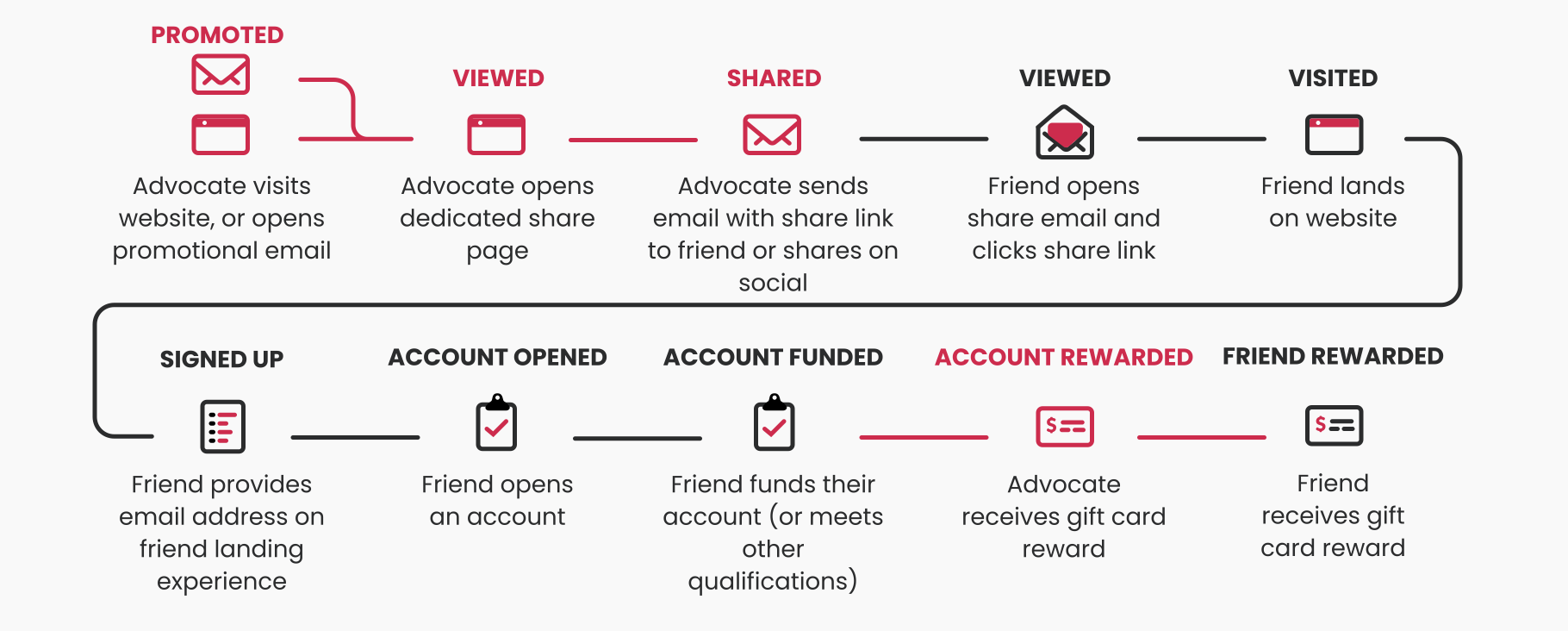
Every good referral program uses rewards. An advocate typically gets a reward when a customer they referred performs a desired action. In financial services, that action is becoming a member of the institution and using its products and services.
A typical financial services referral journey, from the advocate's first visit to the rewards for both sides:
Best practices around rewards are constantly evolving. Coupon codes are still the dominant reward for most retailers, and loyalty points remain the most popular alternative. Account credits and external gift cards, either issued by the same retailer or an open-loop alternative, also remain popular.
However, the nature of financial services processes, products, and requirements calls for a referral approach that differs from traditional models designed for retail or eCommerce. Financial decisions carry greater gravity for most people. Financial institutions also deal with more compliance, regulatory, and privacy concerns than organizations in less regulated industries.
Extole recognizes that uniqueness and follows a different baseline flow for financial services companies. We look at your target customers and provide referral programs that are distinctly focused on the financial services customer profile.
Focus on delivering uniquely financial services referral experiences
1. Referral experiences must be brand-specific
Your messaging material must reflect the look and feel of your institution. The color, transparency, and opaqueness of your buttons and CTAs should reflect your brand. Doing so can improve your brand recognition by as much as 80% and conveys consistency. You can always experiment with colors outside your branding palette to find what works best, but you can never go wrong sticking to what is already familiar.
2. The in-person experience needs to match the online and app experience
Don't neglect the in-branch referral experience. Referrals are happening naturally every day. Create a process that allows your team to capture referrals for members who prefer the in-branch experience.
3. Enable one-click connections between your advocates and their referred friends
90% of Americans will open a text message within three minutes of receipt. Provide advocates with native sharing tools that enable them to connect rapidly with referral candidates.
4. Make it easy for recipients to share branded messages and promos
Make it easy for referral recipients to share too. Even if they don't convert, they can pass the promos on to others who might. 92% of consumers say they trust referrals from people they know, and they are 4x more likely to purchase when referred by a family member or friend.
5. Offer a consistent experience across platforms
Today's customers expect every marketing initiative from financial services organizations to be digitally accessible, seamless, and consistent. 76% demand connected journeys. Your referral program must therefore be accessible and consistent across all digital channels and devices.
6. Make sure your advocate has a great experience
Start by collecting feedback from your advocates on what makes a great experience. You can also use data from previous campaigns to see what works for your advocates and what doesn't. The insights will help you create and deliver advocate-centered experiences.
7. Build a referral system that leverages person-to-person connection
Make it easy for advocates and their friends to communicate. Use one-click chat buttons to encourage meaningful communication between the referrer and the referred.
8. Enable your advocates to personalize their referral message
Friends tend to respond positively to branded messages delivered in a familiar voice or tone. The more personalization, the more impact. Personalizing your promotional emails can improve unique open rates by 29% and unique click-through rates by 41%.
9. Recognize that referred customers are different from other customers
The path to membership for referred customers should have a different starting point, different touchpoints, and different motivations and rewards than that of a standard customer. Showcase the positive experience of current members to referred friends and suggest they can enjoy the same when they sign up.
Avoid dropping referrals onto a standard landing page, confusing them with other offers, or neglecting the social proof that comes with the advocate's recommendation. Design their journey accordingly to give them the best experience.
10. Set security standards to prevent fraud
Referral fraud, such as self-referrals, redeeming multiple offers, and opening multiple accounts, is a persistent concern for financial institutions engaged in referral marketing. Take the measures needed to identify both high-quality referrals and high-risk referrals. For more on this, see how referral tools reduce fraud.
11. Be transparent about consumer data rights and usage
86% of consumers have concerns about data privacy. The good news is that 90% of them also express a willingness to share their data if they have a positive experience with a brand. One surefire way to deliver a positive experience is to secure customer information and be transparent about how it is used.
12. Financial services referrals are not always primed for conversion
Don't treat referred friends as automatically ready to convert, whether that means performing a desired action or opening an account. Enhance their experience by helping them learn more. Their first landing page experience should be all about the value you offer.
13. Use social proof
Reinforce the fact that the referral is coming from a friend. Testimonials and reviews from real people give your referral campaign more weight and credibility. Customers trust positive mentions and statements from people they know, so use that.
Target high-quality referrals with rich rewards
14. Go for high-quality referrals
Implement strict criteria and objectives, such as active bank accounts or being a client for a certain number of months, to make sure referrals have high-value potential. By limiting prospective referrals to a specific set of criteria, you can target the ones who bring more lifetime value to the organization.
15. Leverage burst rewards
Win more attention and create a big, lasting impact with "burst campaigns." Burst campaigns usually offer high-value rewards within a short time frame, like a $500 credit when referrals sign up for a new credit card within a week. When expertly timed and executed, burst campaigns can attract new customers with potentially high value.
16. Don't penny-pinch
Rewards must be compelling and high in value because the lifetime value of financial services clients is considerably high. Customers are extremely discerning when it comes to financial decisions. If they don't think your program will give them value, they likely won't participate.
17. Reward your advocates and referrals fast
The faster people get their rewards, the more engaged they are with your program and your brand. Clients want to enjoy the fruits of their efforts and don't want to wait a long time to receive a reward. When they have done their part, reward them.
18. Reward your advocates aggressively
Even if referred users don't perform your desired actions, it is still beneficial to reward advocates to encourage them to keep participating and sharing. This also helps avoid WISMR ("where is my reward?") inquiries.
19. Expand offerings to non-members of the advocates' circle
By rewarding non-members who share your program, you further grow your customer base and expand the reach of your referral marketing efforts.
20. Cross-sell to drive more value
Cross-selling is a great referral approach for financial institutions. It drives customer lifetime value because it locks in clients for a long period of time.
21. More calls means something's wrong
Call centers in financial services should have a way to issue a reward manually to an advocate who calls in about a missing reward. If call center inquiries grow to more than 1% of the total number of advocates, something is amiss and you should troubleshoot your program setup.
Take a different approach for different customer segments
22. Highlight the benefits
Financial services clients don't think about or see content the way retail clients do. They are more systematic and eager to know the technical details of your offerings. Speak in financial terms, and speak to what matters to people when they're managing their money.
23. Leverage language localization
Engaging referred visitors in their own language drives growth. 84% of B2B marketers say localization positively affected their revenue, and over 72% of customers say they are more likely to buy a product presented in their own language. Localization is about more than translation. It is also a vital step in connecting with potential customers by respecting their customs, traditions, and idioms.
24. Design referral programs based on customer types
Referral programs for more and less affluent customers must be handled differently. Referral journeys for financial services clients are also different from those of retail customers, so don't shoehorn a customer into a journey designed for a retail company. When referral journeys are specific to business segments, you can place touchpoints at optimal stages, which makes interactions more effective and efficient for the customer.
25. Define qualification criteria for referrals and communicate them clearly to advocates
Designing a referral program includes being explicit about eligibility requirements. Your advocates need to know who can send and receive referrals, or they could be deterred from submitting them.
26. Map out the referral journey
Make it easy for advocates to see what steps they need to take to earn their reward. Track and capture all the events in each journey so you can reward for key events, change reward triggers easily, and measure customer quality and drop-off. Optimized referral journeys deliver a better customer experience, and an estimated 86% of consumers say they're willing to pay more for better CX.
27. Personalize your landing page
Too often, businesses direct referred visitors to a standard landing page and fail to use the impact of the advocate's recommendation. It is great to give "first time" offers to anonymous prospects who visit your site, but referred visitors should get a landing page experience that reinforces their friend's recommendation.
Get technical
28. Leverage data for powerful customization
Customization is essential to the success of any form of marketing, referral included. Customized copy and CTAs have been shown to have 42% higher conversion rates than programs with generic messaging. Draw insights from customers' data, preferences, and history to supercharge customization and increase the odds of engagement and conversion.
29. Understand that fonts matter
In marketing, your choice of font, text size, and spacing matters just as much as the message itself. A psychological study found that people tend to assign personalities to fonts, which can shape how they perceive marketing materials. Make sure the "personality" of your font matches your brand.
30. Include the offer in your CTAs
In one test, a marketer placed descriptive copy about a promo first and put the CTA at the bottom, which produced a 304% conversion lift. Recipients prefer to know more about an offer before clicking the CTA button, so give users a glimpse of your program to make your CTAs more encouraging.
31. Make sure your landing page is more than a sign-up page
State what makes your offerings unique and what a referred friend needs to complete in order to get rewarded. Joining a bank is a big decision, so your landing page must contain all the information customers need to make it.
32. Make A/B testing a habit
Run A/B tests on every aspect of your referral program. It gives you a clearer picture of your campaign and lets you keep optimizing performance.
Leverage every innovation
33. Streamline the referral journey with QR codes and deep links
QR codes, mobile share sheets, SMS notifications, and deep links enrich marketing campaigns by linking them directly to media-rich content such as images, videos, events, and landing pages. This eliminates signposting and path guessing. Referred parties can quickly find the item or information they want, which significantly reduces frustration and keeps them moving through the referral journey.
34. Strategically place QR codes
Make it easy for users to find and scan your QR codes. Place them where people have direct access, such as on a desktop so they can easily share from their phones, in customer dashboards, in-store, in-branch, and in printed material. Doing this encourages sharing. For more, see our roundup of QR code referral program tools.
35. Reward advocates based on other factors that contribute to customer growth
Most referral programs reward advocates once they have referred a friend. Financial institutions can benefit from rewarding other actions that don't necessarily lead to a direct purchase but affect the bottom line in the long run, such as the number of leads submitted, customer quality, and journey progress.
Market after the conversion
36. Capitalize on moments of delight
Happy clients are empowered advocates. Turn moments of delight into valuable connections by adding CTAs to triggered emails and thank you pages that promote your program and bring in more referrals.
37. Send new advocates a thank you email when they've completed their first share
Thank you messages are a great way to show how much you value your customers and strengthen their relationship with your brand. 60% of consumers said appreciation should be delivered directly to both the referrer and the referred, and 44% agreed that thank you messages should be personalized to make them more genuine.
38. Review your strategy and modify it if you're not hitting desired thresholds
Every referral marketing strategy has its own set of KPIs to gauge the program's success. If you're not hitting your desired thresholds, review your strategy closely, identify the pain points, and make the necessary adjustments.
Use data to glean high-value, actionable insights
39. Capitalize on high-value customer segments revealed by your referral program
Your referral program is brimming with customer information you can use to create exclusive customer segments. Identify your most loyal advocates and most successful referrals, group them together, and create exclusive offers for them.
40. Discover untapped customer segments based on the firm's existing information
Financial services enterprises have a treasure trove of customer information hidden in their CRMs, ERPs, and other sources. If you're a marketing firm working for a financial services company, start there.
Putting these referral best practices into action
Getting implementation-ready may seem daunting, but Extole has the tools to launch efficient, effective referral programs that check off every item on this list, from customization and sophisticated audience segmentation to data protection and detailed reporting. The platform adapts to your business needs and to the unique steps in your customer journey. Learn more about referral programs for banks and credit unions.
Businesses like yours are driving 10%, 20%, and even 30+% of new customer acquisition through referrals. Request a demo to see how customer-led growth can work for your institution.